12.30.2005

Behind the Great Firewall

I did something rare and difficult: I got my blog read in China (at least by one person). (See the proof here.) My friend Rena helped me gather some of the photos of some of the ugly Chinese sculptures, so I wanted her to see those entries. She's very intellegent and very open-minded (which is a rare quality in the people I met over there, so I feel like I actually can discuss things with her.

She pointed out two sculptures in Tiananmen Square, which have very famous within China. Of the first, Rena writes, "but that soldier sculptures are considered as one of the greatest sculptures after 1949 P.R. China set up in the text book." (Forgive her English, which, all things being equal, is actually very strong, though far from perfect.) As an outsider, it's hard to be enthusiastic about what is actually a pretty straightforward piece of propaganda, all content and no form. Yes, we get it, the communists were heroic and saved China. I don't really take anything from this sculpture, though, as art. There is a more interesting sculpture, across the street in front of Tiananmen proper. It is a marble pillar [华表], traditionally placed in front of palaces and tombs. When I reacted positively to the pillar, Rena had an interesting reaction:

I know foreigners always think these traditional things are much chinese. China is supposed to be like Xi'an
China should be full of old buildings with wing roofs

She raises an interesting question: to what extent is it possible to retain a Chinese identity without just repeating the past again and again? Is it possible to incorporate Western ideas while still being Chinese?

This is actually a much greater issue, which has played out repeatedly throughout the history of music. American composers faced the same struggles with the influences of European music. Conventional wisdom has it that it wasn't until the turn of the 20th century that Charles Ives solved that problem (though I think people don't give William Billings full credit). Russia had its own conflict in the second half of the nineteenth century. (For that matter, look at the wave of nationalistic composers who felt compelled to assert their own countries' musical autonomies throughout the century.)

The problem is particularly strong in China, however, because of its history. From the end of the nineteenth through the first half of the twentieth century, there was a strong foreign presence in certain areas. Suddenly, after the revolution, that ended. The next twenty five years featured strict isolation, until foreign influences were gradually allowed again. The result is a country that today is still struggling to find a voice. (I'm glossing over a lot of issues for the sake of length, although those may come up in future posts.)

It's encouraging to talk to Rena and know that she struggles with these questions, as a young citizen of the country. It's not just up to the artists to find an identity.

12.27.2005

WCRB

I was listening to WCRB in the car this evening. Something pretty strange happened. After the first movement of the fifth Brandenburg Concerto, they played a very unexpected piece -- the second movement of the concerto. Maybe the third movement followed, but by then I had arrived at my destination.

Yes, the demise of WCRB will be a little sad, as Boston should have a full-time classical music station, but the peope lamenting its impending format change as part of the death of classical music are missing part the point. In its current format, WCRB is hardly friendly to classical music. It's not just that the station only plays a very small selection of music, pretty much excluding anything written before 1700 or after 1900. It isn't even their terrible habit of playing just one movement from a piece.

WCRB's real problem is that it has a very negative attitude about the music it plays. Again and again and again, they talk about "relaxing" classical music. (Even to bizarre effect -- I remember one time several years ago when the relaxing piece the host was plugging turned out to be Beethoven's 5th.) In CRB's world, classical musc isn't something that is supposed to engage the mind; it is supposed to turn the mind off.

I think if WCRB respected its listeners a little more, maybe it would be doing a little better. Instead, it tries to cultivate brain-dead listeners by making classical music into a brain-dead product.

Addendum:

Today, WGBH pulled a CRB-style move, and played just the Adagietto from Mahler's 5th. (I didn't believe my ears until their website confirmed it.) But I'm much more willing to cut them some slack -- they have an interesting and eclectic playlist, and don't treat their audience like idiots.

-12/30/05, 22:11

The Art of the Public Square

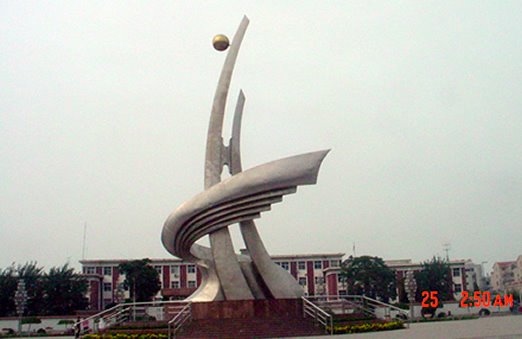
My first day in Jinan, as my roommate took me on a tour of the city, he pointed out the large blue sculpture in the center of Quancheng Square. "All Chinese cities have them," he told me. The sculpture is a little bizarre, to say the least: two blue posts, seemingly made of fiberglass, which twist around a metallic globe in the center. In some ways, it's an exemplary giant Chinese public square sculpture. Based on just this picture, it isn't entirely clear what it is, or what it is meant to represent (other than Jinan's greatness that the city could build such a monument to itself). Although some of these sculptures are truly abstract, they tend to be abstractions of the square they sit in. But how do you represent a public square? In Jinan's case, it's pretty easy. 泉城广场 means "City of Springs Square," after one of Jinan's old names. Accordingly, you color the sculpture blue and show its components gushing from the ground to represent a spring. (Just try to ignore the fact that all but twelve of Jinan's 200 springs were paved over to build this square and its surrounding areas. Who needs a natural heritage when you have sculptures?)

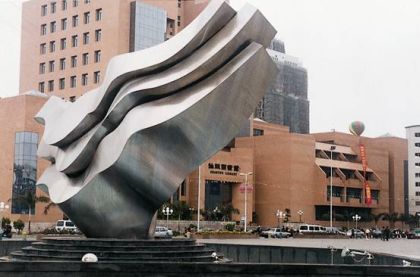
Most public squares in China, though, don't have names as evocative as "City of Springs." How do you depict Civilization Square, for example? The solution used in this sculpture in Jiangyin, a small city in Jiangsu Province on the southern banks of the Yangtzi River, is to depict the word civilization itself. The Chinese word -- 文明 -- has two components. The 文 is unmistakable. (I'm not certain of this, but I believe that the version shown in the picture is in Chinese seal script.) 明 itself consists of two different characters: 日, meaning sun, and 月, meaning moon. Furthermore, texts in Chinese are traditionally can be written top to bottom. This sculpture is just the name of the square written large. (It is also a fitting sentiment for the front of the city government building. Google images has some other photos that give a good sense of its placement.)

Not all the sculptures are able to make such a connection, however. Dalian's Zhongshan Square, named after Dr. Sun Yat-sen, the founder of modern China, chooses a glowing orb as its centerpiece. The round sculpture is fitting for the center of Dalian's giant rotary at the center of the city. As you can see, at night, it lights up the square around it. (Or, at least the center of the square -- the edges of the square are lit up by the adjacent billboards and buildings.) However, it's hard to get excited about a sculpture whose chief influence is Epcot Center.

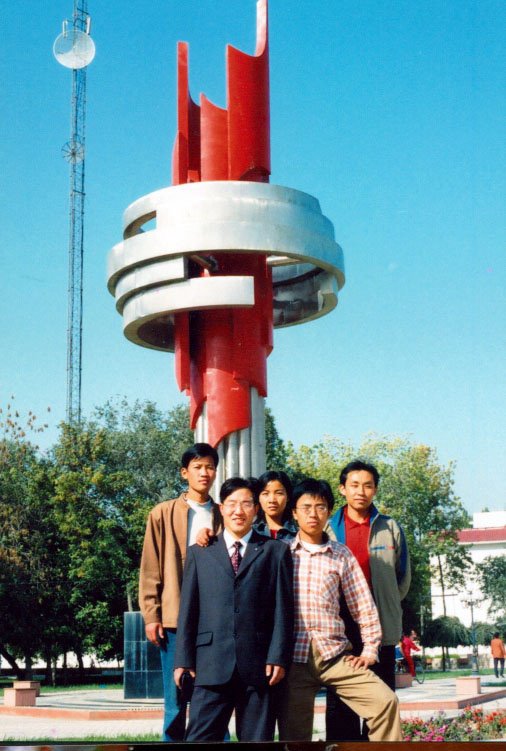
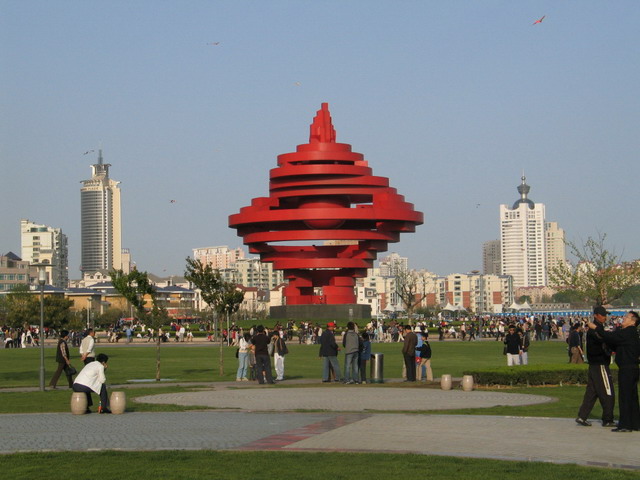
Strange as it may sound, these are some of the normal ones. Consider the People's Square in Qinhuangdao. Legend has it, the great emporer Qin Shihuang went there seeking immortality. It is also the the point where the Great Wall reaches the sea. (More recently, it is the largest port in Hebei province since Tianjin left to become an independent municipality.) The square doesn't choose to explore the city's history, though, and the result is a very forgettable sculpture. There is little to distinguish it from its counterpart in People's Square in Linyi, a small city in southeastern Shandong Province. The Mayor of Linyi boasts of the city's heritage as the home of ancient manuscripts of Sun Tsu's Art of War and great figures from China's history. (Notice how the sculpture is used as the web sites icon -- they are choosing it to be the symbol for the city.)

What's the difference between these sculptures, though? They share the same Chinese red color, the same tripod structure, and the same jagged edges. An argument could be made that Qinhuangdao's version focuses itself inward, whereas Linyi's pushes outward, but that's a bit of a stretch. There is nothing to connect one to Qinhuangdao and the other to Linyi -- they could easily be swapped, and the cities would be no better or worse for it.

These sculptures are a uniqely Chinese phenomenon. I'd like to conclude with a picture of the mother of them all: the earliest such sculpture. This one is made of iron, in the far western city of Bali [巴黎, not to be confused with Bali in Indonesia]:


(See also photo supplement)

Public Square Sculptures Supplement

Suzhou

Shantou

Location unkown
Lihu

Qingyuan

Changchun

Qingdao

Tianjin

12.24.2005

Maestro Levine

Scott Simon has a nice story on James Levine.

It's a matter of pride that in this Mozart year, the BSO is choosing to focus on Beethoven and Schoenberg. Also, anyone who can get Schoenberg, Carter, Varese, Wourinen, and the like on WCRB is truly a hero in the field.

12.23.2005

Gift-giving Dilemma

My grandmother's birthday is on Boxing Day. My family gave me a mandate for her birthday present: find $50 worth of Mahler CD's. My initial reaction was to get her 1, 2, 5, and 9. 2 is my favorite at the moment, 9 is so profound, and 1 and 5 are so famous, how could I go wrong with those? Looking through the 9's, I came across this recording, paired with two pieces by Pierre Boulez. I think Notations is a real knock-out piece (I found the old Erato recording at For the Record used some years back), but can I really get it for my grandmother?

Yes, I'm an unashamed evangelist of great music. I would love it if everyone would give Boulez the chance his music deserves (and think that a lot more people would find they actually like it if they just listened to it with their ears open).

But can I really get some Boulez for my grandmother? I'm already getting her Mahler, so she does listen outside of the tightly confined 1700-1900 WCRB box. Am I such a partisan that I will get my grandmother Notations for her 85th birthday?

The answer is no. I ended up picking out some nice recordings conducted by Bernstein, because she probably fell in love with his recordings forty years ago. I guess there are some lines even I won't cross.

Poieticism and Gnarlyism

Over at Sequenza 21, they're having very interesting debates on the poietic fallacy fallacy and gnarlyism.

The basic idea is that no composers write music thinking that won't touch their audience. This raises all sorts of questions, many of which have to do with so-called "gnarly" composers, i.e., the high modernists.

It made me think of a juicy quotation from a composer who actually didn't write music to touch his audience. Why not? Because to him, music wasn't capable of doing so:
I consider that music is, by its very nature, essentially powerless to express anything at all, whether a feeling, an attitude of mind, a psychological mood, a phenomenon of nature, etc.
Which gnarlyist said that? Was that from the grandfather of them all, Schoenberg? Or did the most partisan serialist, Pierre Boulez say that? Babbit? Wournien? Rochberg?

None of them. In fact, it was said by the opposite camp: Igor Stravinsky.

It puts the whole debate in a very different perspective, doesn't it?

The saddest thing is that this same Stravinsky who isn't out to move his audience has somehow remained popular, while the "gnarlyists" are only now making inroads with the public. We always love those who hate us.